Ladders, Drainpipes and Dirty Tricks: The Lost-Ball Ritual That Stops Sunday League Dead
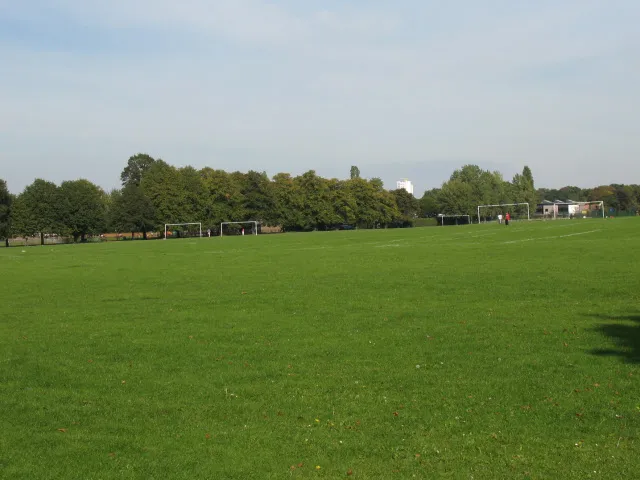
Photo: Stephen Craven, CC BY-SA 2.0, via Wikimedia Commons
The moment the game stops
It starts with a thud. Not the good kind — not a shot hitting the stanchion or a header thumping off the crossbar. This is a hollow, rattling thud, followed by a silence that spreads across the pitch like a cold front. Every player turns. The ref checks his watch. The gaffer mutters something about 'bloody hell, not again'. And there it is: a match ball, sitting smug on the clubhouse roof, wedged against a chimney pot or resting in a gutter like it's been placed there by a higher power with a sense of humour.
Sunday league has plenty of delays. A late arrival, a missing boot bag, a referee stuck in traffic on the ring road. But none of them unite a touchline quite like the stranded ball. It is a problem with no obvious owner and no obvious solution, and yet everyone — players, subs, spectators, the bloke walking his dog — immediately has an opinion on how to get it down.
A brief economy of borrowed ladders
The first phase is always denial. Someone insists it's not that high. Someone else says they could reach it if they stood on the wheelie bin. Then comes the ladder. Where it comes from is never entirely clear. A groundskeeper's shed, a neighbour's garage, the back of a plumber's van that happens to be parked nearby — Sunday league has a way of producing equipment at the exact moment it is required, like a magic trick performed by a man in a Hi-Vis jacket.
The ladder is rarely the right ladder. It is a step ladder when you need an extension, or an extension when you need something with a stabiliser bar. It gets carried across the pitch by two people who are definitely not qualified to carry it. Someone holds the bottom. Someone holds the top. Someone stands back and says 'that doesn't look safe' while doing absolutely nothing to make it safe. The ref, meanwhile, has adopted the expression of a man who has already added three minutes and is now considering adding five.
The tactical pause
Here's the thing about a ball on the roof: it is only a delay if you want it to be. If your team is 1-0 up with eight minutes left and the opposition is pressing like a team possessed, that ball is a gift. Suddenly your centre-half becomes an engineer. He wants to assess the angle. He wants to check the ladder's feet. He wants to discuss whether a long-handled broom might be better than a ladder, and whether the broom is in the shed or at the chairman's house.
The opposition captain knows exactly what's happening. He's pointing at the roof, then at his watch, then at the ref, in a little triangle of outrage. The ref is unmoved. The ref has seen it all before. The ball on the roof is a neutral event, technically. The game is stopped. Nobody is to blame. And yet somehow the team that needs a breather always seems to be the team whose player last kicked it up there.
Send for the kid
There is always a kid. Every grassroots ground has one: a nine-year-old in a hoodie, fuelled by Haribo and a complete absence of fear, who has already identified the drainpipe as a viable route. The parent says 'absolutely not' and then watches with a face like a clenched fist as the kid shins up the pipe, grabs the ball, and drops it down to a round of applause.
The kid gets a fiver from the fines pot. The kid gets a nickname that will follow him for the next fifteen years. The kid has become, briefly, the most important person at the club. He doesn't even play for either team. He's just the lad who lives in the house next to the ground, and he has now achieved more in one Sunday morning than some of the players will manage all season.
What the roof actually holds
If you ever get up there — and someone eventually will, probably with a proper ladder borrowed from a proper builder — you'll find the roof is a museum of lost things. A deflated size four, a traffic cone, a single goalkeeper glove, a flat football from 2019, a shoe that nobody has claimed. The match ball is just the latest exhibit. The clubhouse roof is the club's unofficial archive, and every stranded ball adds another page.
The restart, and the point
Eventually the ball comes down. It's muddy. The ref blows. The game resumes. Nobody remembers who was winning the argument on the touchline, because the argument has been replaced by a shared story. That's the thing about the lost ball: it is ridiculous, it is irritating, and it is entirely pointless. But it also turns a match into a little community project. For five minutes, everyone had a role. The ladder holder, the angle assessor, the kid on the drainpipe, the bloke saying 'leave it, it's gone' from the comfort of his fold-out chair.
Grassroots football runs on improvisation. A pitch with no drainage. A linesman with a borrowed flag. A changing room with one working shower. And a ball on the roof that nobody can reach, but everybody tries to solve. It's the most hated delay in the game — and secretly, it's one of the best bits.