Call It in the Air: The Ridiculous, Sacred 30 Seconds That Start Every Grassroots Game
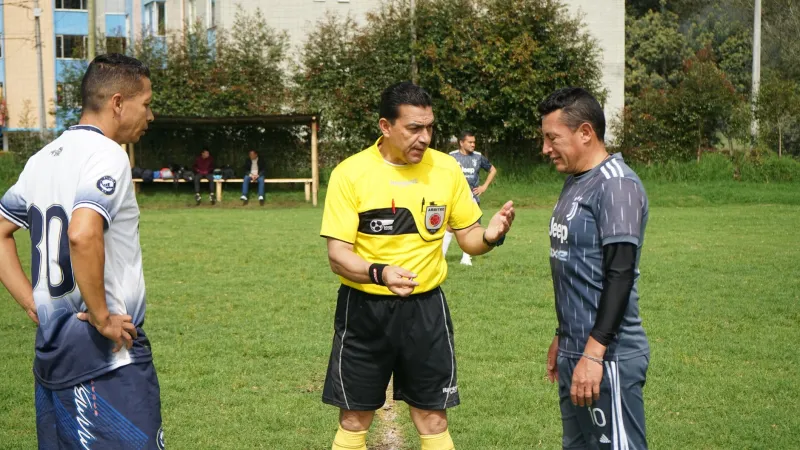
It's 10:28 on a Sunday morning. The 3G cage smells faintly of rubber crumb and the bloke who unlocks the pavilion is still doing the padlock with one hand while holding a bacon roll in the other. Twenty-two players are pretending they've warmed up properly. The referee, a man who has already been asked three times whether he's got the right pitch, digs into his pocket and produces a coin.
And just like that, the most serious piece of nonsense in grassroots football begins.
The Thirty Seconds Before Everything
The coin toss is a ritual nobody trains for and everybody has an opinion on. It is not the match. It is not even the warm-up. It is the administrative equivalent of a handshake, except there's a 50/50 chance someone will claim they called it before it landed, and a further 50/50 chance the coin will disappear into a puddle never to be seen again.
Ask any skipper and they'll tell you the same thing: they've been doing this since they were 14 and they still don't know why they bother. "I say heads every week," says Dean, who has captained a Sunday side in the Midlands for the best part of a decade. "I've probably lost more tosses than I've won. But if I said tails and we lost, I'd be thinking about it all game. So I don't."
That's the thing about the toss. It is a decision-making process that has been stripped of all logic and replaced with superstition, habit and the vague hope that calling correctly will somehow translate into a fast start. It never does. But the alternative — just deciding who kicks off, like adults — feels wrong.
Heads, Tails and the Skip Who Can't Lose
Every club has one. The captain who calls heads without hesitation, as if the coin has personally offended him before. The one who insists on calling tails because his grandad did. And the one who tries to be clever by asking the referee to "show me the coin first" — a manoeuvre that has never once changed the outcome but adds a lovely five seconds of drama to proceedings.
There is also the captain who wins the toss and immediately hands the kick-off to the opposition. This is a power move. It says: we are so confident in our second-half performance that we are willing to spend the first 45 minutes chasing shadows in the wind. It rarely works. It is always respected.
And then there's the referee's version of the ritual. Not all heroes wear capes; some wear a lanyard and a whistle and have to explain to two grown men that no, they cannot both call heads. "I've had captains argue about the toss for longer than they've argued about a penalty," says Rachel, who has been refereeing grassroots games for six years. "I just want to get on with it. But I've learned to let them have their moment. It settles everyone down. It's like a little ceremony."
When the Wind Wins
Let's talk about the weather, because the coin toss is the only part of the match that's genuinely affected by it. If you've ever stood on a touchline in November, you'll know that a coin tossed into a gust can end up anywhere. It can go backwards. It can go sideways. It can land in the centre circle and then get blown towards the corner flag while everyone watches in silence.
The best ones are the referees who try to catch the coin mid-air. They always think they can do it. They never can. There's something beautifully undignified about a man in a black kit lunging for a 5p piece while twenty-two players watch and the linesman pretends not to see.
"I lost a coin in the mud at a game in January," says Tom, a club secretary in the North West. "We never found it. Ref had to use a two-pence piece from his pocket. The captains were fine with it. The coin was not the point. The point was that we did it properly. We didn't just guess."
Why We Still Bother
Here's the thing. The coin toss doesn't decide anything. It doesn't change the pitch, the weather, the squad or the result. It's a formality. But it's the formality that says: we are here, we are taking this seriously, and we are going to do it the same way we've always done it.
For the players, it's the last quiet moment before the shouting starts. For the refs, it's a chance to get everyone looking in the same direction. For the touchline, it's the only time all morning they shut up and pretend to care. And for the bloke with the bacon roll, it's the signal to put the kettle on.
So next time your captain calls heads and the coin lands tails, don't groan. Don't question it. Just clap, pass the water bottles and get on with it. Because the toss is not nonsense. It's the nonsense that makes grassroots football make sense.
And if you're really lucky, the referee will drop the coin. That's the whole ritual, right there.